
Agricultural Robotics
Agricultural Robotics & Smart Farming Automation
Agricultural robots powering the next generation of automated agriculture. Through integrated farm automation systems, precision agriculture robotics and intelligent farming robots, we engineer scalable robotic solutions that optimize yield performance, enhance operational control and enable sustainable, data-driven agricultural management.
Agricultural Robots Transforming Modern Farming
Agricultural robots are redefining how modern farms operate in an era of labor shortages, climate variability and rising operational complexity. As farming operations expand, traditional processes struggle to maintain efficiency and consistency across large cultivated areas.
The convergence of robotics and agriculture enables a shift toward fully automated agriculture, where farming robots operate autonomously to monitor crops, collect field data and support precision decision-making. These agrobots function as intelligent field units within a broader farm automation system, continuously analyzing environmental conditions and crop performance.
By integrating agricultural robots into structured automatic farm systems, farmers transition from reactive management to predictive, data-driven agricultural control. Instead of relying on estimation, modern farms leverage robotic farm equipment and automated agriculture systems to increase productivity, optimize resources and improve long-term sustainability.
Agricultural robotics is no longer experimental technology — it is becoming foundational infrastructure for scalable, efficient food production.

From Field Data to Automated Action
How Agricultural Robots Transform Data into Scalable Farm Automation
Modern agriculture generates vast amounts of field data, but without structured systems, that data remains underutilized. Our agricultural robots are engineered to capture, analyze and act on real-time environmental and crop information within integrated farm automation systems. Through precision agriculture robotics, intelligent sensing and autonomous execution, we convert raw field data into measurable operational outcomes.
By combining robotics and agriculture through scalable automated agriculture architectures, we enable structured workflows that move beyond manual estimation. From crop monitoring to irrigation control and harvesting operations, our farming robots operate as connected components within a unified automated agriculture system. The result is greater visibility, improved resource allocation and consistent field performance across complex farming environments.
Engineered Agricultural Robots for Scalable Farm Automation
We design and integrate agricultural robots engineered for specific farming operations across open fields and controlled environments. Each robotic platform is developed as part of a structured farm automation system, combining precision agriculture robotics, environmental sensing and intelligent control to support scalable automated agriculture deployment.
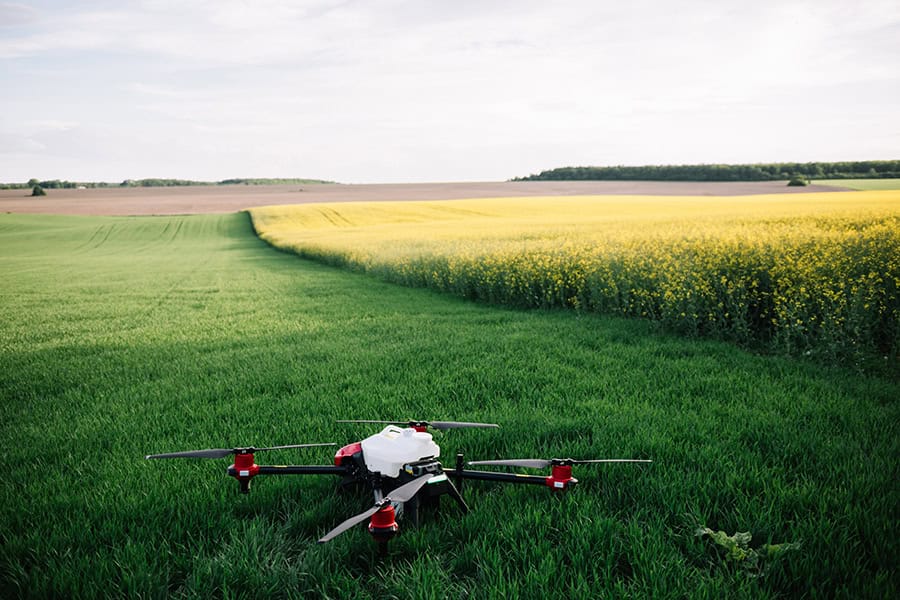
Crop Monitoring & Field Inspection Robots
We develop crop monitoring agricultural robots engineered for autonomous field navigation and continuous plant analysis. These systems integrate computer vision and environmental sensing to detect early-stage disease, water stress and irregular growth patterns before visible damage spreads.
Embedded within structured farm automation systems, they convert raw field data into predictive insights that strengthen operational planning and yield forecasting.
Key Capabilities:
- Autonomous navigation between crop rows
- High-resolution plant imaging
- Leaf condition and discoloration analysis
- Early disease and stress detection
- Plant growth measurement
Precision Spraying & Weed Control Robots
We engineer precision spraying agricultural robots designed to replace uniform field treatment with plant-level intervention. These precision agriculture robotics platforms combine intelligent detection and targeted application to optimize resource usage.
Integrated into automated agriculture systems, they reduce chemical waste while maintaining consistent treatment performance across large-scale operations.
Core Functions:
- Weed identification using AI detection
- Targeted plant-level spraying
- Precision fertilizer application
- Reduced pesticide consumption
- Optimized environmental impact


Greenhouse & Indoor Farming Robots
We design greenhouse agricultural robots built for climate-sensitive and controlled farming environments. These agri robot platforms monitor environmental variables and integrate into automatic farm systems to maintain consistent production conditions.
By combining sensing, irrigation control and crop handling, they enable stable indoor automated agriculture workflows.
Operational Capabilities:
- Continuous plant health monitoring
- Automated irrigation adjustment
- Temperature and humidity tracking
- Indoor harvesting assistance
- Produce transport support
Harvesting Assistance Robots
We develop harvesting agricultural robots equipped with advanced vision systems and adaptive robotic arms. These farming robots support high-value crop collection where timing, consistency and precision are critical.
Integrated into automated agriculture systems, they reduce chemical waste while Integrated into scalable automated agriculture systems, they reduce labor dependency while maintaining product integrity during harvesting cycles.consistent treatment performance across large-scale operations.
Functional Capabilities:
- Fruit ripeness detection
- Precise crop positioning analysis
- Optimal picking angle calculation
- Soft gripping mechanisms
- Damage-free harvesting execution


Soil & Environmental Analysis Robots
We build agricultural robots capable of collecting soil and environmental metrics to support precision agriculture robotics strategies. These systems integrate field measurements into structured farm automation platforms for actionable insight generation.
By converting environmental data into digital intelligence, they enable data-driven agricultural management instead of estimation-based decisions.
System Capabilities:
- Soil moisture measurement
- Temperature monitoring
- Nutrient level analysis
- Plant stress detection
- Digital field reporting
Autonomous Tractors & Field Vehicles
We engineer autonomous agricultural vehicles designed for repeatable and precise field operations. Integrated positioning systems and robotics system control ensure structured automated agriculture deployment across large farming environments.
These robotic farm equipment platforms reinforce scalable farm automation system performance through consistent navigation and task execution.
Field Capabilities:
- Autonomous plowing operations
- Precision crop seeding
- Structured row cultivation
- GPS-guided path execution
- Centimeter-level spacing accuracy

Technology Behind Our Agricultural Robotics Systems
Integrated AI, positioning and control architectures
We do not supply standalone machines.
Agricultural robots operate as intelligent systems within structured farm automation environments, where reliable sensing, real-time analytics and coordinated execution are essential. Our agricultural robotics platforms are engineered to combine precision agriculture robotics, environmental data acquisition and autonomous control into unified automated agriculture systems.
Rather than functioning as isolated machines, these systems integrate positioning technologies, AI-driven perception, robotics control software and wireless connectivity to deliver consistent operational performance. This integrated architecture allows agricultural robots to execute field tasks with measurable accuracy while maintaining scalability across diverse farming environments, from open-field cultivation to controlled indoor production facilities.
Architecture Layers

GPS Positioning & Navigation Systems
Our agricultural robots utilize advanced GPS and RTK positioning to ensure accurate navigation and repeatable path execution. These systems support structured row alignment, optimized spacing and reliable autonomous movement across large agricultural environments.

Computer Vision & AI Analytics
We integrate computer vision and AI-driven analytics into farming robots to enable real-time crop inspection and environmental interpretation. These technologies allow automated agriculture systems to detect anomalies and respond with precision.

Environmental Sensor Integration
Our agricultural robotics platforms incorporate soil and climate sensors that continuously monitor moisture, temperature and nutrient conditions. This sensing layer strengthens precision agriculture robotics strategies and supports data-driven farm automation decisions.

Robotics Control Architecture
We engineer robotics control systems that coordinate navigation, data processing and mechanical execution within agricultural robots. This architecture ensures synchronized task sequencing and stable automated agriculture deployment.

Wireless Communication & Farm System Integration
Our automated agriculture systems enable real-time data exchange between agricultural robots and centralized farm management platforms. This connectivity supports synchronized operations, remote monitoring and scalable farm automation workflows.

Start a Robotics Engineering Discussion
Every operational environment is different.
Factories, hospitals, logistics centers, solar parks and smart buildings require autonomous robotic systems engineered around real constraints, safety standards and performance targets.
Our robotics engineering team evaluates your operational workflow, technical requirements and integration complexity before defining a structured development strategy. From robotic system design and hardware architecture to AI robotics software and cloud robotics platform integration, we approach each project as an engineered solution — not a product sale.

Agricultural Robotics FAQs
Key Questions About Agricultural Robots, Automated Agriculture Systems and Operational Impact
Agricultural robots are deployed as structured components within scalable farm automation systems. Their role extends beyond task automation to measurable operational impact, including yield predictability, resource optimization and workflow stability. Below are the most important questions related to deployment, performance and integration in modern automated agriculture environments.
What operational improvements can agricultural robots deliver?
Agricultural robots increase yield predictability through continuous crop monitoring and real-time environmental analysis. Integrated into automated agriculture systems, they improve operational consistency and strengthen production planning across large farming environments.
How do agricultural robots integrate into existing farm infrastructure?
Through robotics system integration and custom automation architecture, agricultural robots connect with existing machinery, GPS systems and farm management software. Deployment is structured to minimize disruption while enabling gradual automation scaling.
What level of autonomy is supported in automated agriculture systems?
Agricultural robots can operate in assisted, semi-autonomous or fully autonomous modes depending on infrastructure readiness, regulatory requirements and project scope. Autonomy levels are configured based on operational risk assessment and workflow design.
What technologies enable precision agriculture robotics?
Precision agriculture robotics relies on GPS-RTK positioning, computer vision, AI analytics, environmental sensing and robotics control architecture. These technologies function as an integrated system rather than isolated components.
What is required for agricultural robotics deployment?
Deployment requires infrastructure assessment, positioning calibration, data integration planning and operational workflow alignment. Agricultural robots are introduced as structured system components within a defined farm automation strategy.